Meet the witnesses.
A worker, a household, a court. Hear what each person knows, and what they need you to remember.

Four eras / One sacred duty
Someone is being left out of tomorrow.
Listen to their stories. Choose what survives.
Private beta · Desktop browser recommended
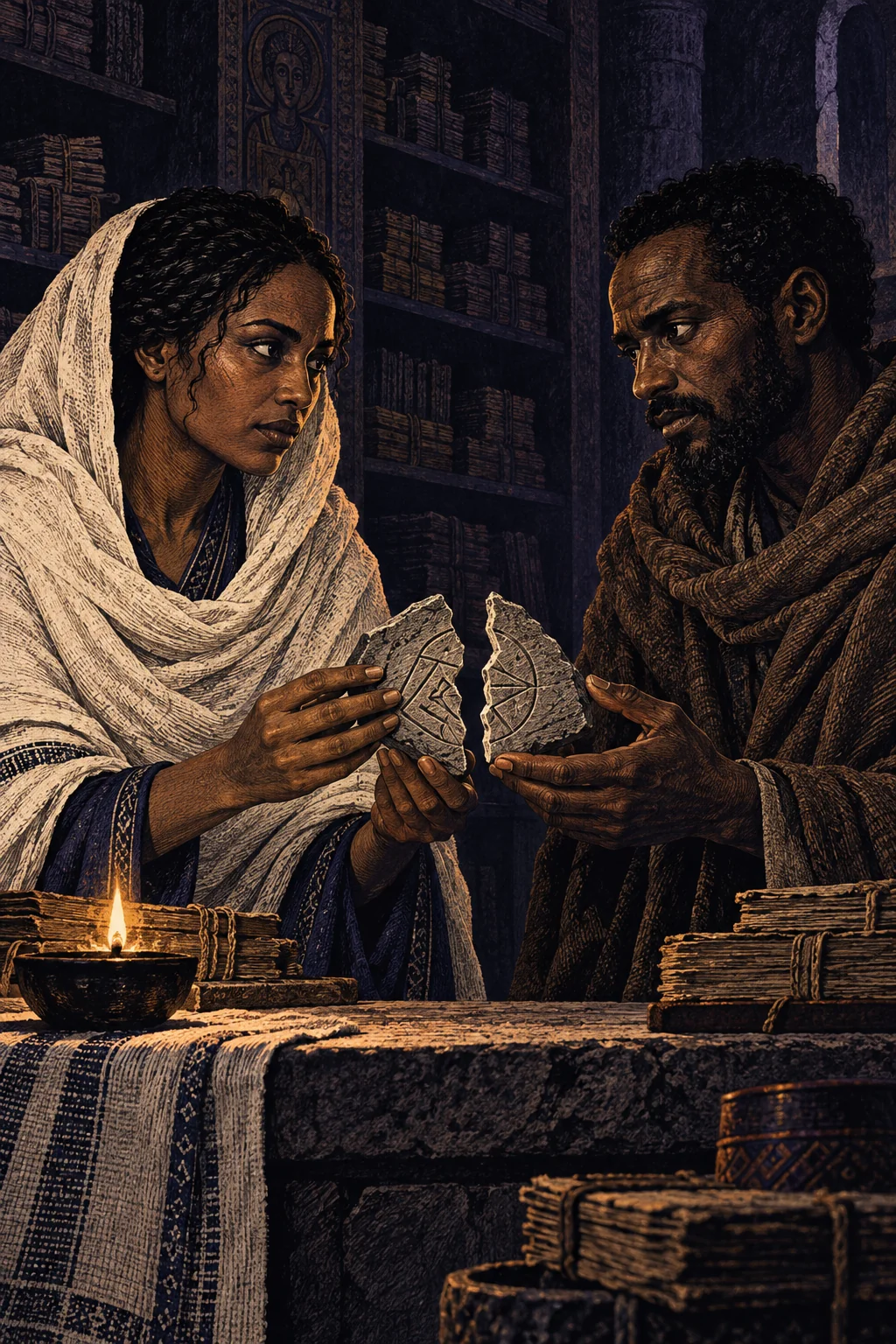
The Keeper’s Threshold · Illustration from the game

The Order of Keepers
A household gave you shelter. A mentor taught you to listen. Now she puts the stylus in your hand.
In the game’s fictional fellowship, children raised by the Order carry its deepest trust. Others arrive from courts and workshops. You owe no service for your shelter. You choose the duty.
Across four eras of Ethiopian history, successive Keepers inherit that duty: hear the people an official account might leave out, and decide what the future will remember.
“Someone is being left out of tomorrow. Go and learn their name.”
How the record is made
A narrative game of conversations, investigation and lasting choices. Follow one main journey in each era, with room to take the detours.
A worker, a household, a court. Hear what each person knows, and what they need you to remember.
Walk the places behind the testimony. Take an optional investigation when a story asks for a closer look.
Decide whose testimony belongs in the record. A clear instruction leads you onward; the judgment remains yours.
Seal your inscription. Revisit it in your Chronicle, and see how later voices respond to what you preserved.
Four eras of Ethiopian history
Twenty-four explorable settings. Different witnesses, competing accounts, and a record that outlives its maker.
Can one origin story contain everyone who built this place?
From Yeha’s temple court to the households of Mezber, listen for the people behind an origin story.
What changes when the conquered can answer a monument?
Hear accounts of royal authority, faith and exchange. Decide how a changing kingdom will describe itself.
Whose names survive when a new court takes over?
Follow stone from the Quarry through the Royal Workshop. Whose names will survive beside the patron’s?
What does a Keeper owe a record that power wants simplified?
Enter courts, archives and communities where inherited records meet the people who must live with them.
Grounded in historical research, with interpreted settings and fictional conversations. In-game notes distinguish the evidence from the story and offer sources for further reading.
An invitation to the first witnesses
Keepers of Memory is in private beta. Tell us where you lost your way, whose story stayed with you, and what you wished you could do next.
Founding Keepers can choose to have their names included in the game’s Roll of Keepers.
No installation. Desktop browser recommended. Phone and tablet gameplay is still being evaluated.
You were not supposed to find this
You were taught to witness.
What if witnessing is not enough?
Some Keepers broke the Order’s first law. They stepped into the history they were sworn only to record.
Enter the Convocation. Hear their reasons. Decide what you would have risked.
A hidden game within Keepers of Memory.
Seven cells. One memory. Six playable campaigns across seventeen centuries — twenty-eight endings, and the network remembers every one. Your record in one century changes how the next one greets you.

Campaign settings in the full game. These are fictional alternate histories, not reconstructions of events.
Website preview · A fictional alternate-history dilemma. Choices here are temporary and do not transfer to your game save. The full campaigns are inside the game.
Before any hand is raised, the Archive requires the reading of what history built through these lives.
In this imagined record, a survivor arrives with the gifts of a teacher. The Archive asks you to weigh the lives he might shape against the life before you.
The other survivor is a witness in his own right. The game asks whose account disappears when a Keeper decides someone else’s future.
The future ruler stands beyond this first decision. In the campaign, a choice made at the harbor reaches into the court and its record.